Sprinkler inspection checklist
This is a monthly visual check of a fire sprinkler system: are the heads clear, is the control valve open, and are the pipes free of leaks? Print the checklist below, or use the same template on a phone in MintCheck.
Sprinkler check
MonthlyHeads, control valve and piping
- Site and location
- Date
- Checked by
| Item | Result |
|---|---|
| Heads clear of obstruction | |
| Control valve position | Open (normal)Closed (faulty) |
| No pipe leakage | |
| Notes | |
| Overall result | NormalAbnormal |
Template from MintCheck · mintcheck.today
How to do each check
Heads clear of obstruction
Walk through the area and look up. Storage, shelves and partitions shouldn't stand close under a head, and nothing should hang from one. Heads shouldn't be painted, dirty, corroded or damaged. Don't touch a head to check it, because a damaged head can release water.
Control valve position
Find the valve that controls the water to the sprinklers and check its position. Many valves have an indicator that shows whether they are open.
- Open (normal): the valve is fully open, and locked or sealed if yours should be.
- Closed (faulty): the valve is closed or only partly open. The sprinklers behind it may get too little water or none at all.
Pipe leaks
Look along the pipes you can see, and around the valve, for drips, wet patches or rust.
Notes
Write down anything else, such as a gauge reading, a missing seal, or new shelves or a new wall near a head.
How often to check
This template is set to monthly. Some rules ask for valves to be looked at more often, sometimes weekly, and for the whole system to be inspected and tested by a qualified company at set intervals. The rules differ by country and type of building, so check the ones that apply to you.
A visual check doesn't replace inspection and testing by a qualified company.
If something is wrong
- Mark it on the checklist and describe the problem. A photo helps.
- If a control valve is closed or partly open, tell the person responsible for fire safety right away. Don't open it yourself unless you are authorized to, because it may be closed for repair work.
- Move stored goods away from a blocked head. Call your sprinkler company for leaks, damaged heads or anything else.
- Ask whether your rules require extra measures while the system is out of service.
- Check it again after the fix and record the result.
Use this checklist in MintCheck
- In Checklists, click Add checklist and pick the sprinkler template. Its items and monthly schedule are filled in, and you can change them before you save.
- In Assets, click Add asset, pick the sprinkler template and link the checklist. Add one asset for each control valve or zone, and one checklist can serve them all.
- Click Print QR and put a label on or next to each valve.
- Workers scan the label, answer the items and mark the result Normal or Abnormal. They can attach photos.
An Abnormal result stays Unresolved until a re-inspection confirms the fix, and the site dashboard shows completed inspections against the planned number.
Control valves are often in a plant room or a riser cupboard that a new worker may not find. Upload a floor plan to the asset and put a pin on the valve. Workers can then open the plan from the asset screen, and only signed-in workers and administrators can see it.
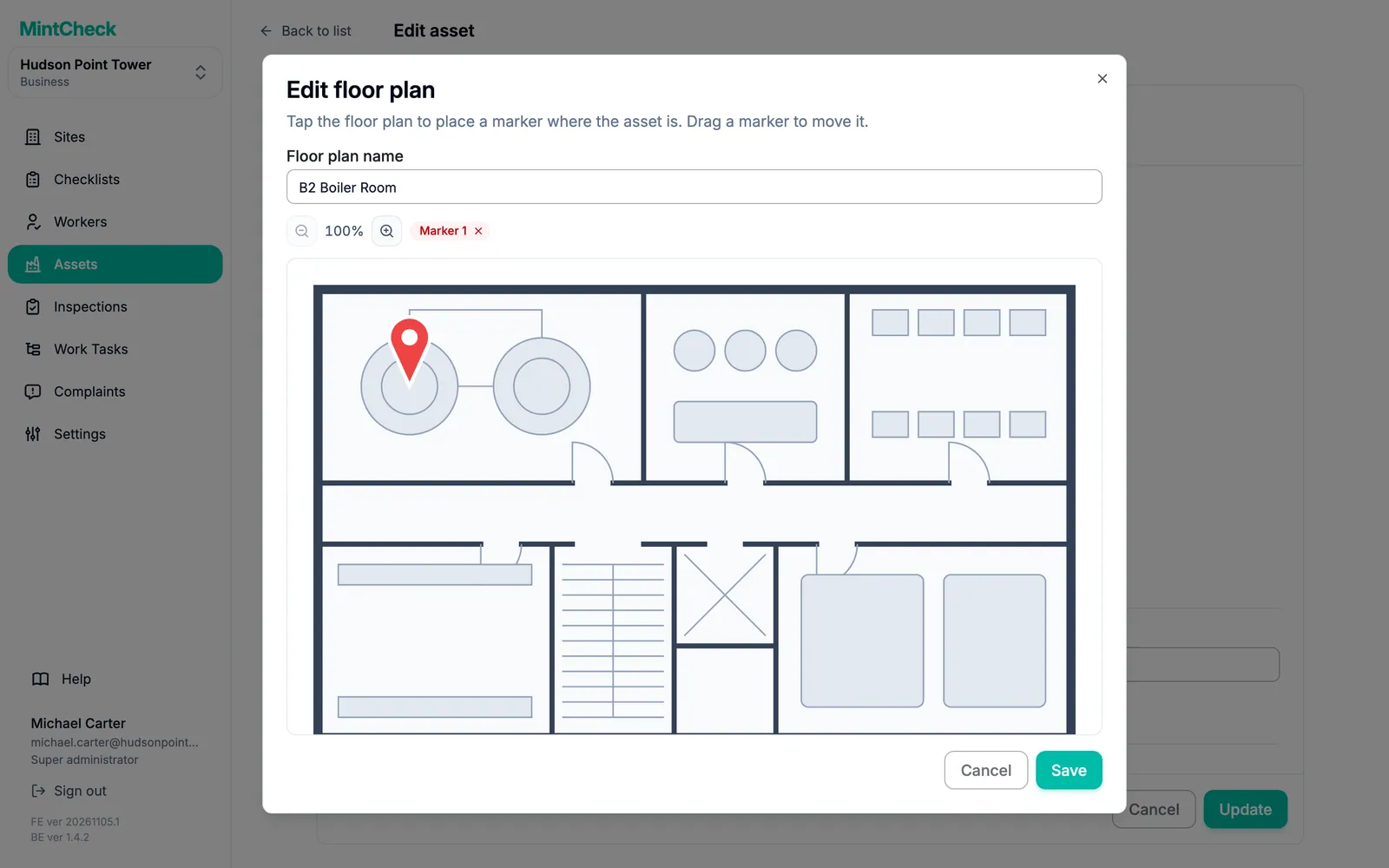
MintCheck is free for up to 5 assets with no credit card, so you can try this with a few zones.
Common questions
How often should fire sprinklers be inspected?
This template uses a monthly visual check as a starting point. Some rules ask for valves to be checked more often, and required intervals differ by country and type of building, so check the rules that apply to you.
How much clear space does a sprinkler head need?
It depends on your rules and on the type of head. Many rules set a minimum distance between a head and anything stored below it. Find the distance that applies to you and write it on the checklist.
Why must the control valve stay open?
Sprinklers can only spray the water that reaches them. If the valve is closed, the sprinklers behind it may not work in a fire, even if everything else looks normal.
Does this checklist replace a professional sprinkler inspection?
No. It is a routine visual check and a starting point, not a statement of compliance. Inspection and testing by a qualified company are separate.
Who can do this check?
Someone on site can usually do it once they have been shown where the valves are and what the open position looks like. Your local rules may say who can do what.